First Published Draft of GDD (9/10/2020)
Introduction: Word Wizards is designed to offer a new perspective on both word games and turn-based combat by combining the two genres together. The following text describes the game’s concept and how it works:
Summary
Genre: Turn-based Word Building RPG
Word Wizards is a 2D turn-based RPG in which one good Word Wizard named Lang goes on an adventure to battle evil Word Wizards through turn-based combat. During combat, each Word Wizard can spell out English words using a set of Letter Pieces to perform actions. Throughout the game, other good Word Wizards will join the player’s party. The goal of the game is to restore order to its world by defeating all of its evil Word Wizards.
Core Game Loop
In exploration mode, the player controls Lang in eight directions in a top-down environment. Lang interacts with various objects and NPCs to unlock other areas within the game world and go on side quests. When the player encounters a bad Word Wizard, the player enters turn-based combat mode. During combat, control swaps between the player and enemy teams after their action count runs out or passes their turn. The process repeats until all of one team has been defeated. If the enemy team has lost, the player returns to exploration mode. If the player team has lost in any combat encounter, the player has lost the game. If the player defeats all bad Word Wizards in the exploration environment, the player has won the game.
Design Pillars
- Turn-based combat
- Word building
- Top-down exploration
Systems
Inventory System (Letter Bank)
Each character’s inventory, also known as its Letter Bank, is allotted a number of slots to store Letter Pieces. The number of slots each character’s Letter Bank has is dependent on its Letter Bank capacity (see Characters). Each character’s Letter Bank is completely filled at the beginning of each combat round, meaning that any empty slots are filled with new Letter Pieces. Empty slots can also be filled outside of combat by collecting Letter Pieces in the exploration environment. Any time a new Letter Piece is collected, at least one slot has to be empty in that character’s Letter Bank. If no slots are empty within a character’s Letter Bank, the player has the option to replace the Letter Piece in any slot with the newly collected Letter Piece. If there are at least one empty slot, the new Letter Piece is assigned to the first available slot in the order in which the Letter Bank slots are arranged.
Example: [K] + [A] , [ ] , [E] , [F] , [W] , [ ] , [D] -> [A] , [K] , [E] , [F] , [W] , [ ] , [D]
In the above example, the 2nd and 6th slots are empty. A ‘K’ Letter Piece is added to the above Letter Bank in the 2nd slot because the 2nd slot comes before the 6th slot.
Turn-based Combat System
In each combat encounter, the combat system switches control between the player’s team and the enemy team each round. Unless a specific encounter specifies otherwise, the player’s team gets to go before the enemy team. At the beginning of each round, each unit’s Letter Banks are refilled to match the number of Letter Piece slots in its Letter Bank, which are all visible to other units (including opponents). During the player’s turn, the player can cycle between its heroes and each hero can perform as many actions as the number of words that its Letter Pieces can spell. Each action requires the character to use their Letter Pieces found in their Letter Bank toward an action to spell out a word.
Example: [C] , [A] , [T] , [D] , [O] , [G] , [S] = CATS & DOG or CAT & DOGS or …
If the player decides to go with the above example, that Letter Bank’s assigned character can use each of those words with one action each, meaning that player unit can perform 2 actions in that same turn.
Wizards can perform two types of actions: Attack and Magic. Attack actions allow wizards to cast a bolt out to an opponent to deal damage. Characters can attack more than once during their turn. Magic actions allow wizards to cast spells that target a given unit or team. Wizards can only use one Magic action per turn and each spell has a delay in turns (cooldown period) before it can be used again. Once the player runs out of actions, control automatically passes to the enemy team. Though, the player can choose to pass its turn to the enemy team. During the enemy team’s turn, enemies perform actions in the same way as player characters, but their words and actions are decided by AI algorithms. Once the enemy team runs out of actions, control passes back to the player’s team and the combat cycle continues until no more units of one side are left standing.
Core Mechanics
Top-down Movement and Exploration
The player controls the main character, Lang, in a top-down environment outside of combat. Lang can move in eight directions within the environment using the WASD keys. Lang also interacts with NPCs and encounters evil Word Wizards during its adventure. Certain areas within the environment cannot be accessed without completing quests from NPCs or gaining enough experience from defeating evil Word Wizards. There will also be obstacles for the player to collide into and then avoid while navigating through the environment.
Word Building
Most actions in the game require the player to spell out a word using each wizard’s Letter Bank. Players cannot spell words with less than 3 Letter Pieces. Each Letter Piece has a score associated with it, which depends on the letter. The effectiveness of an action is determined by the word’s sum of scores on each Letter Piece and the number of Letter Pieces used. The table below outlines the base score of each Letter Piece.
| A = 1 | E = 1 | I = 1 | M = 2 | Q = 4 | U = 1 | Y = 3 |
| B = 2 | F = 2 | J = 4 | N = 1 | R = 1 | V = 3 | Z = 4 |
| C = 2 | G = 2 | K = 3 | O = 1 | S = 1 | W = 3 | Wild = 0 |
| D = 2 | H = 2 | L = 1 | P = 2 | T = 1 | X = 4 |
Some Letter Pieces can be color-coded which indicate some buffs or debuffs to each word caster. There are a total of 9 colors that letter pieces can have and are selected at random for each new Letter Piece. The table below outlines the effect that each colored Letter Piece brings to the player upon usage toward a word.

Playable Characters
Lang
Lang is the leader of the party and, as such, is the party’s source of encouragement. Lang’s spell, Power Spell, gives all party members (including himself) a damage bonus to words they spell in that same turn. The number of bonus damage points given to each party member will depend on the word score that Lang earns from casting this spell.
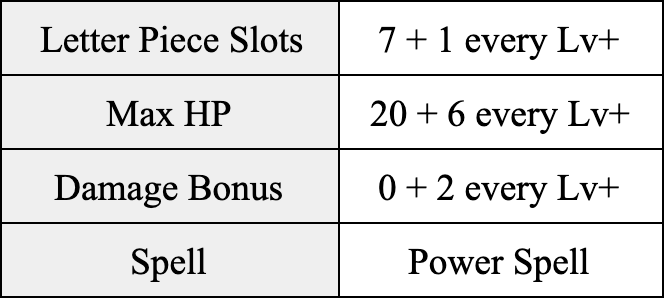
Power Spell Word Example: C-A-T = +4 Damage Points.
Letta
Letta is the party’s supporter and can heal her party by a spell called Express of Relief. Express of Relief replenishes the health of all party members by a certain number of points. The number of health points to replenish will depend on the word score that Letta earns from casting this spell.
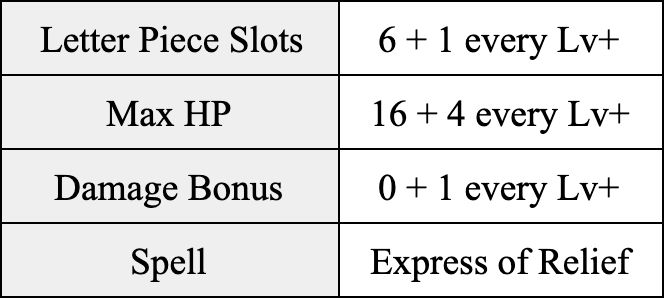
Express of Relief Word Example: R-A-T = +3 HP
Gram
Gram is the party’s source of wisdom and has access to a lot of letters. Gram can also cast a spell called Letter Delivery, which gives all party members bonus letters to use toward spelling a word, which do not count toward their inventory limit. The letters can also be used in between turns, meaning they are not required to be used in the same turn as when Gram casts the spell. The number of letters that Gram gives to each party member will depend on half of the word score that Gram earns from casting this spell. The final letter count granted from this spell is rounded down (floored) to a whole number.
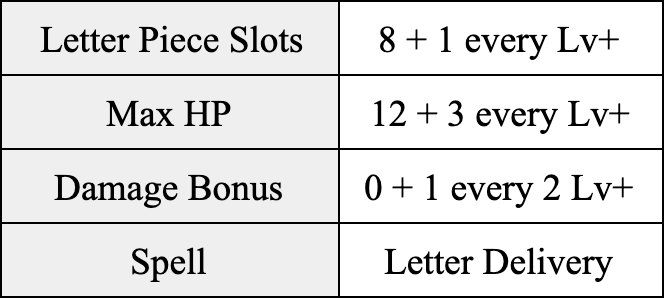
Letter Delivery Word Example: K-I-N = 5 -> 2.5 -> 2 Bonus Letters
V. Larry
V. Larry is the party’s most magical Word Wizard and is the reducer of threats. Larry can cast a spell called Colorful Language, which gives all party members a positive color on a number of Letter Pieces and removing a negative color on that same number of Letter Pieces. The number of Letter Pieces on each party member’s Letter Bank that are affected by this spell depend on half of the word score that Larry earns from casting this spell. The final letter count granted from this spell is rounded down (floored) to a whole number.
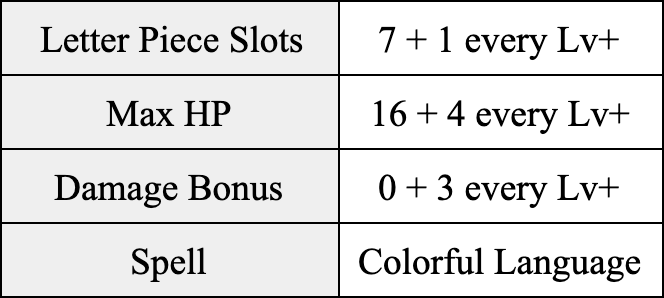
Colorful Language Word Example: W-O-R-D = 7 -> 3.5 -> Remove 3 negative colors, Add 3 positive colors
Art Style
The art style for that this game will incorporate is 2D top-down pixel art. The art style is similar to Wargroove’s art style because the pixel art is simple yet effective.
Audio Style
The audio style is chiptune music and sound effects. The audio style is similar to retro arcade games like Galaga and Pac-Man.
Justification
Lang the Word Wizard offers a new take on turn-based RPGs due to the combination of turn-based combat and word building. This game should be made to give players a new perspective on the genres this game covers.
Update to Documentation
Based on feedback I received from my peers, I decided to make three changes to my documentation:
- I clarified what each Letter Piece color does for the speller and how colors form on each Letter Piece. I divided the Letter Piece colors into three categories to identify their effect and effect target: Neutral, Positive, and Negative. A RNG will select which category of colors to spawn on any given Letter Piece (see documentation for exact stats). I even added another type of color to both the Positive and Negative color categories.
- I added word score bonuses that are applied to any words of a particular letter count (see documentation for exact stats). I thought this was a nice suggestion because it rewards players for spelling bigger and more complex words.
- The last change is adding visual aids such as tables and a flowchart to convey more information about spelling examples and magic spell examples.
 NanoSharkGames